The First Gold Coins

Before coins, people paid with lumps of metal weighed out on scales — slow, and open to cheating. Then, around 600 BCE, a small kingdom in western Turkey did something that changed the world: it stamped lumps of gold and silver with a lion, guaranteed their weight, and called them coins.
In short
The first coins were struck in Lydia, in what is now western Turkey, in the late 7th century BCE, around 610-600 BCE. They were made of electrum, a natural alloy of gold and silver panned from the Pactolus River, and stamped with a lion. King Croesus, who ruled about 560-546 BCE, then issued the first pure gold coins — the Croeseids — alongside pure silver coins.
Electrum from the Pactolus
Lydia's wealth came from its rivers. Electrum, a natural alloy of gold and silver, was found in the beds of the Pactolus River and other Lydian streams. Natural electrum is roughly 80-90 percent gold and 10-20 percent silver, but laboratory analysis shows the early Lydian coins were about 54 percent gold, 44 percent silver, and 1-2 percent copper — the Lydian mint had learned to separate the metals and add silver back in, setting the value itself.
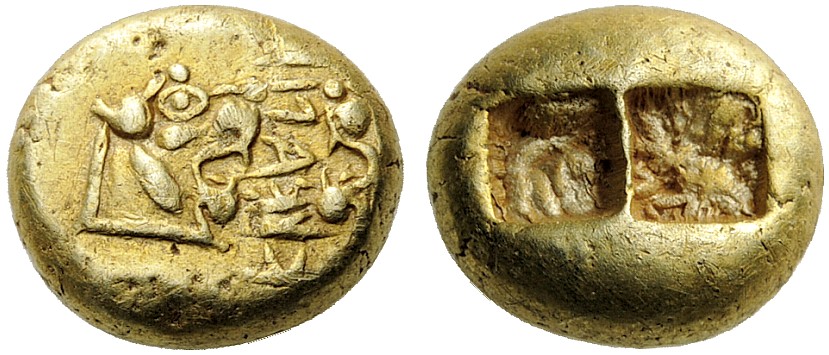
The earliest coins were small, irregular lumps of electrum stamped on one side with the head of a lion, the emblem of the Lydian kings, and punch marks on the other. In 1904-05, archaeologists digging beneath the Temple of Artemis at Ephesus found 93 of these coins left as offerings in the late 7th century BCE. Six carry the Lydian inscription WALWET, which many scholars read as the name of King Alyattes — tying the coinage to the royal house at Sardis, the Lydian capital.
Why a stamp mattered
The stamp was the revolution. A lump of electrum had to be weighed and tested every time it changed hands, because its gold content varied. A stamped coin of fixed weight, guaranteed by the king, could be accepted on sight. Half of the Ephesus coins weigh less than 1.2 grams, and the smallest Lydian fraction, a 1/96 stater stamped with a lion's paw, weighs 0.15 grams and measures 4 millimetres across — proof that coins were used for small everyday payments, not only for large ones.
Croesus and pure gold
The first pure gold coins were issued by Croesus, the last king of Lydia, who ruled from about 560 to 546 BCE. His mint at Sardis dropped electrum and struck separate coins in refined gold and refined silver. The Greeks called them Croeseids, after the king. The gold stater of Croesus weighed about 10.8 grams and was over 99 percent pure.
Croesus became so famous for his wealth that "rich as Croesus" is still said today. Herodotus, writing about a century later, credited the Lydians as the first people to mint gold and silver coin. The fixed ratio between the gold and silver pieces created the first bimetallic system — two metals, one money.
What came after
Cyrus of Persia took Sardis in 546 BCE, but the Croeseids outlived their king. The Persians kept striking them, then replaced them around 500 BCE with the gold daric and the silver siglos. From Lydia the idea spread to the Greek cities, then to Rome, then to the whole world. Every coin in your pocket descends, in a straight line, from a stamped lump of Lydian electrum.
Sources: LBMA, "Lydian Electrum Coin"; Archaeological Exploration of Sardis, "Coins of Sardis"; The Archaeologist, "The Role of the Lydians in the Invention of Coinage" Checked 27 November 2026.